Research Vision
The AURA Lab’s research focuses on how people, buildings, and urban infrastructure respond to extreme weather, infrastructure disruption, and compound hazards. We develop data driven and AI augmented modeling approaches that integrate human mobility, shelter seeking behavior, building performance, and energy vulnerability. Climate change is increasing the frequency and severity of extreme heat, winter storms, flooding, and power outages, while aging infrastructure and social inequities make many communities more vulnerable to these disruptions. A central goal of our work is to support more adaptive, equitable, and human-centered urban resilience planning.
Research Topic
- Human-Centered AI — Modeling human behavior, mobility, and adaptation using empirically grounded AI agents and large language models.
- Urban Digital Twins — Integrating human behavior, built systems, and environmental hazards into unified simulation environments for resilience planning.
- Building & Energy Resilience — Assessing how buildings and occupants respond to extreme weather and energy disruptions, and developing strategies to improve thermal and energy resilience.
- AI for Sustainable and Resilient Construction — Applying artificial intelligence, digital fabrication, and robotic construction to develop lower-carbon and more resilient built systems.
Current Projects
AI-Augmented Urban Resilience Agents
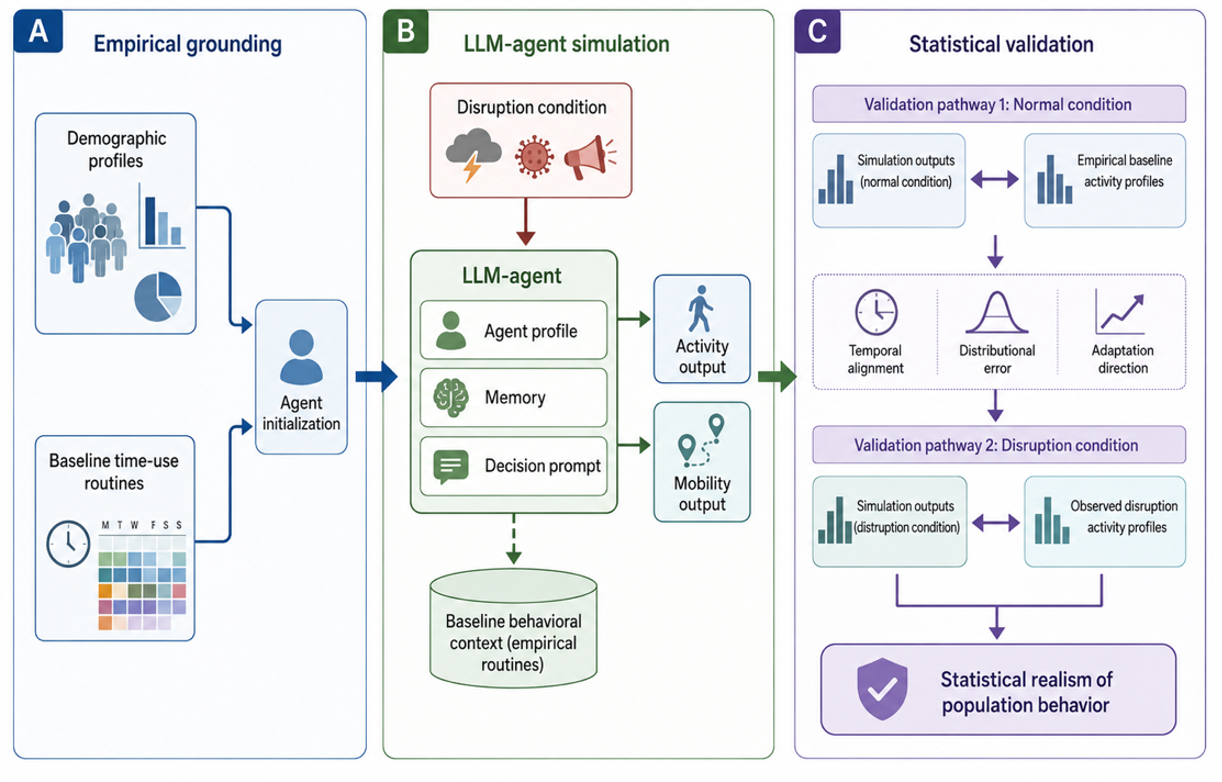
This project develops empirically grounded AI agents that simulate how different residents move, make decisions, and respond during extreme weather events such as blackouts. By combining activity-pattern models with LLM-driven, theory-based decision-making (grounded in frameworks such as Maslow’s hierarchy of needs), the agents transition realistically from normal daily behavior to disaster response. The framework is being applied to simulate blackout response across Philadelphia neighborhoods, supporting more equitable emergency planning.
Predictive AI for Cooling Center Utilization During Heatwaves
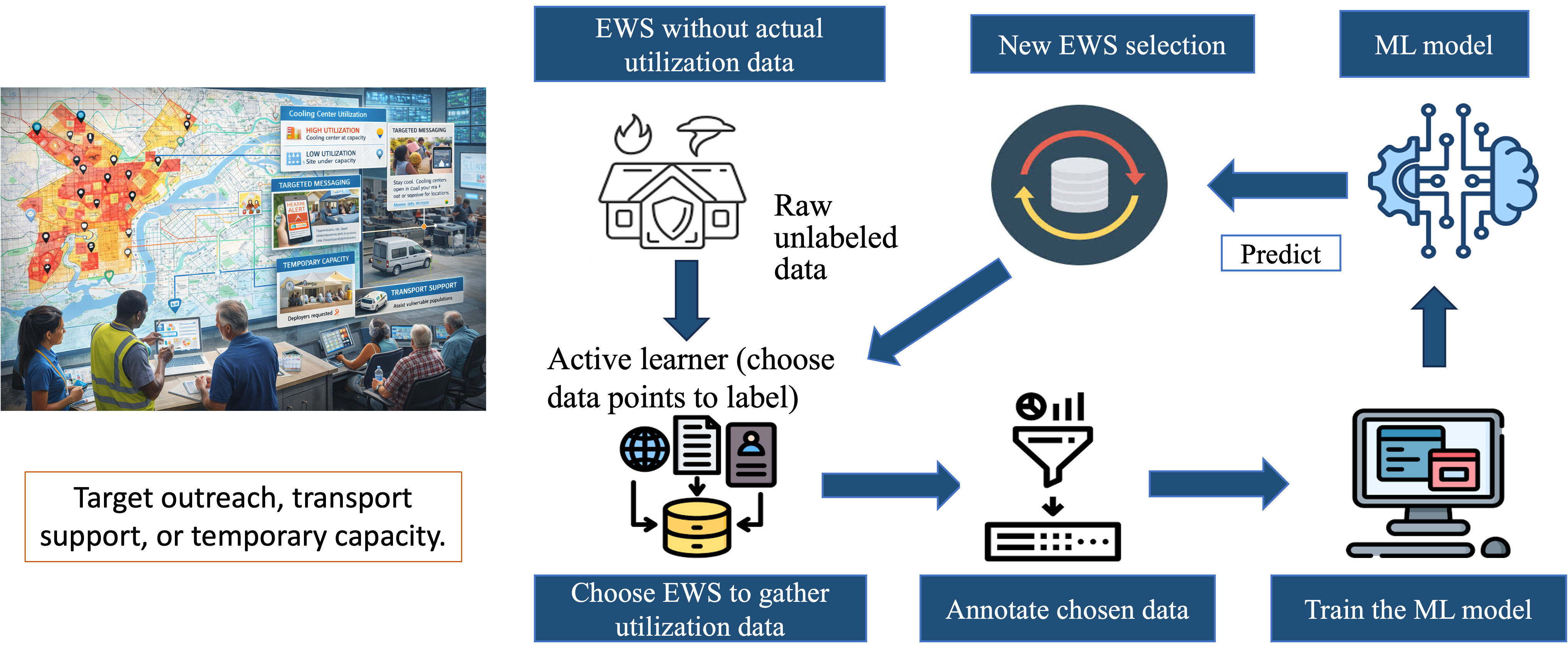
This project builds a machine-learning pipeline to predict utilization of extreme-weather shelters (such as cooling centers) that currently lack historical usage data. Using an active-learning approach, the model iteratively selects which shelters to monitor, gathers labeled utilization data, and retrains to improve predictions for new sites. The goal is to help cities target outreach, transportation support, and temporary capacity where it is needed most during heatwaves.
Human-Centered Building Energy Vulnerability
 |
 |
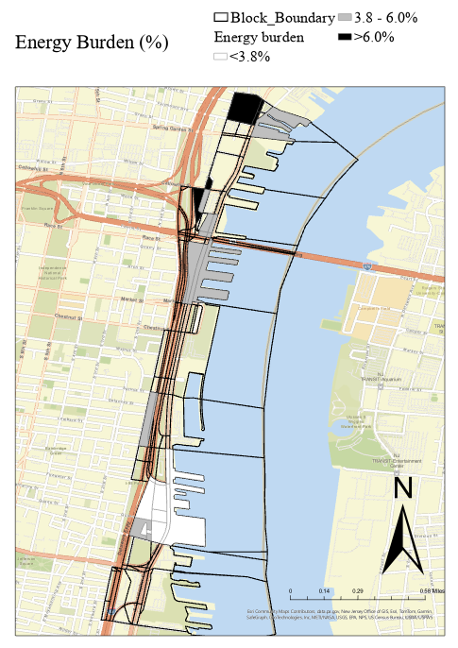 |
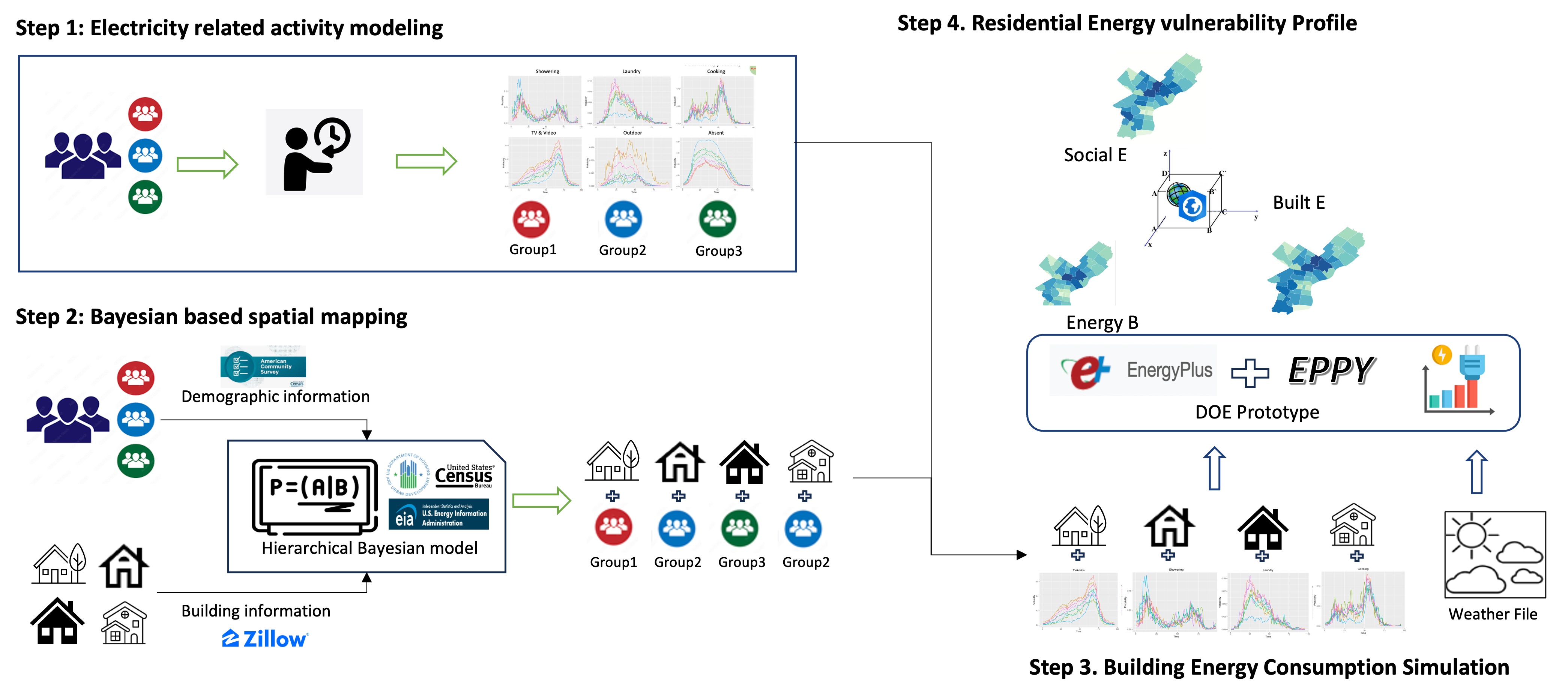
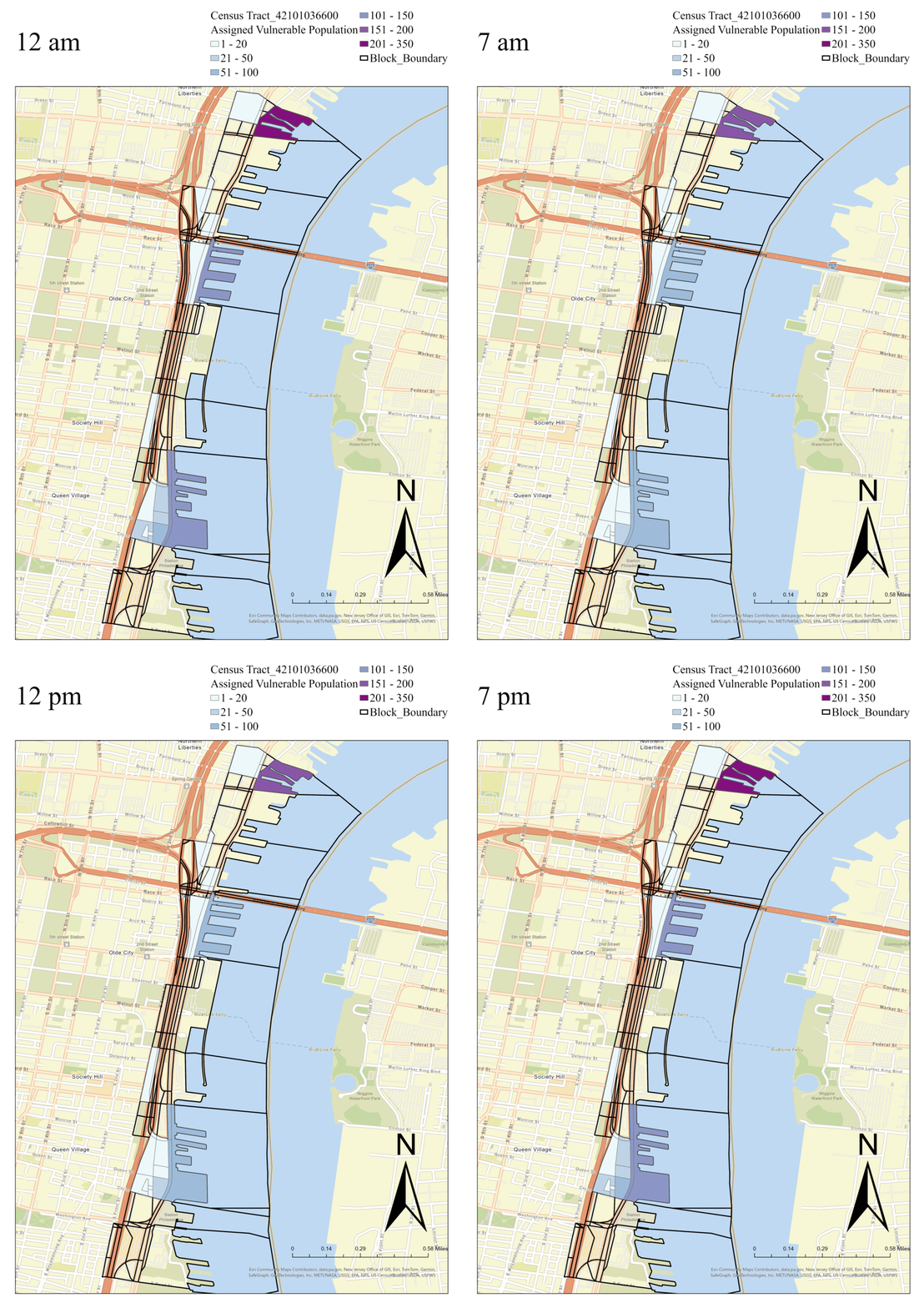
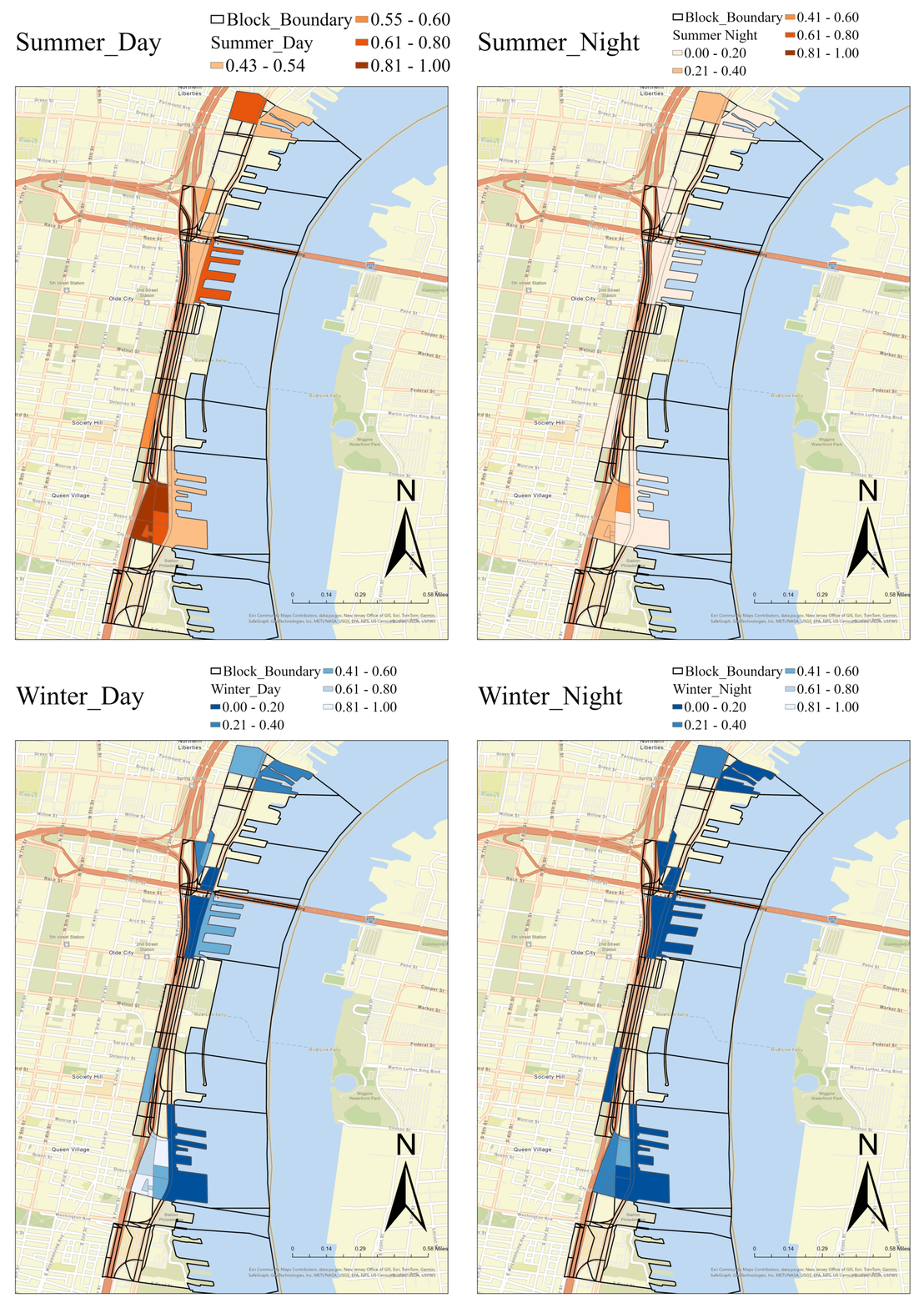
This project links occupancy demographics with building characteristics through Bayesian spatial mapping, then simulates household energy consumption to profile social vulnerability, building resilience, and energy burden. Applied to a high-risk census tract in Philadelphia, the maps above show how vulnerability shifts throughout the day as residents move, and where energy burden is highest regardless of household income. Building on this foundation, current work is extending the framework with AI-driven modeling to better anticipate and respond to energy vulnerability under compound hazards.
Simultaneous Multimaterial 3D Printing Digital Twin
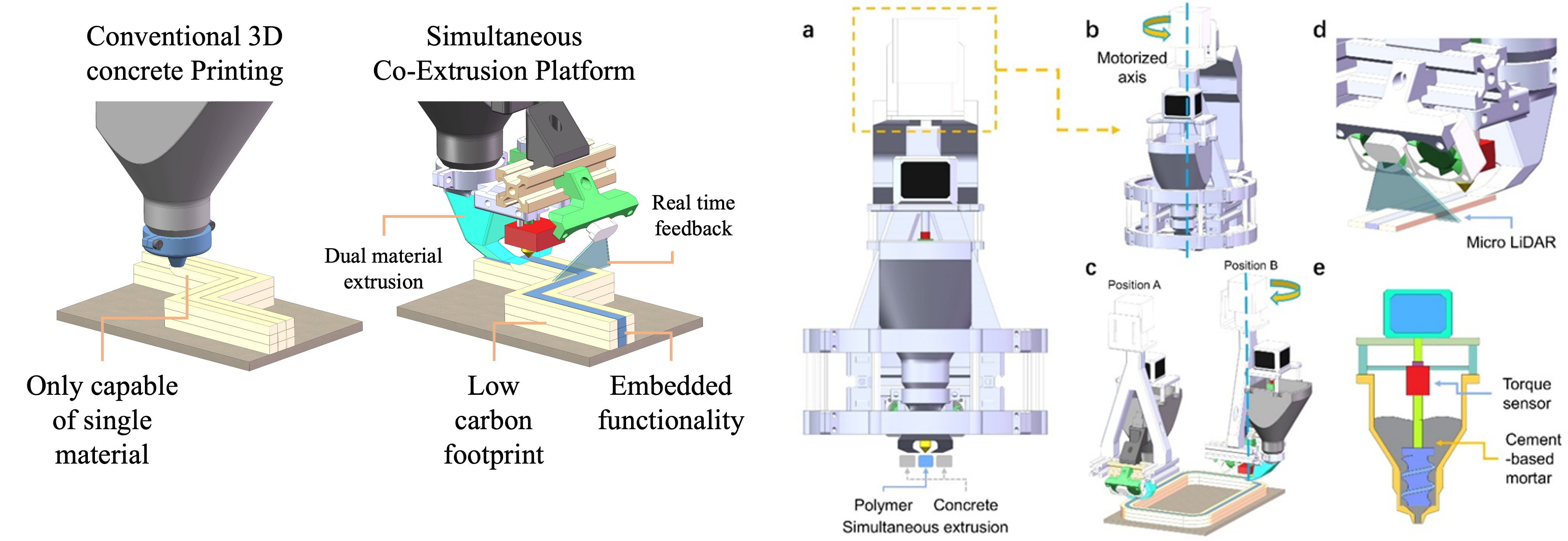
This project develops a cyber-physical manufacturing platform capable of simultaneous polymer–concrete co-extrusion, enabling a single print process to combine structural strength with embedded functionality and a lower carbon footprint. The system integrates a synchronized dual-channel printhead with real-time rheological and geometric sensing to enable closed-loop control during printing, moving beyond the limitations of conventional single-material 3D concrete printing.